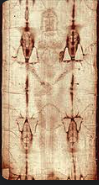
Positive image
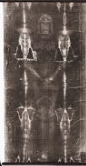
Negative image — reveals the face
What Is the Shroud of Turin?
The Shroud of Turin is a strip of linen cloth approximately 14.3 feet long and 3.7 feet wide, bearing the faint image of a man who appears to have suffered crucifixion. It has been housed in the Cathedral of Saint John the Baptist in Turin, Italy since 1578, though its history traces further back through France, Constantinople, and ultimately to the ancient Near East.
The image on the cloth shows the front and back of a human body — as if the man were laid on one half of the cloth and the other half folded over him. The figure shows wounds consistent in extraordinary detail with the Gospel accounts of the Passion of Jesus Christ: scourge marks across the back and legs, puncture wounds around the scalp consistent with a crown of thorns, nail wounds through the wrists, and a lance wound in the right side. This cloth is not a medieval painting. Decades of rigorous scientific investigation have established that much beyond any reasonable doubt.
The STURP Investigation (1978): What NASA Scientists Found
In 1978, the Shroud of Turin Research Project (STURP) assembled one of the most distinguished teams of scientists ever brought together to study a single artifact. Thirty-three researchers from institutions including NASA, Los Alamos National Laboratory, Jet Propulsion Laboratory, the U.S. Air Force Weapons Laboratory, and major universities spent 120 continuous hours in direct, hands-on examination of the cloth using the most advanced imaging, spectroscopic, and chemical analysis technology available.
Their collective conclusion, published in peer-reviewed literature, was unambiguous: the image on the Shroud was not produced by paint, dye, powder, or any other artist's medium. It was not a photograph. It was not burned onto the cloth by any heat source they could identify. The image could not be reproduced by any known human technique, ancient or modern. The team found no evidence of brushstrokes, no directionality consistent with an applied medium, and no pigment particles embedded in the cloth's weave.
The Photographic Negative and the 3D Encoded Image
For four centuries after its public display, the Shroud was regarded as a faint, almost indistinct relic. That changed in 1898 when Italian photographer Secondo Pia was permitted to photograph the cloth. When he developed the negative plate in his darkroom, he was stunned: the negative of his photograph revealed a clear, detailed, natural-looking positive image of a human face — beautiful and lifelike in a way the cloth itself had never appeared to the naked eye.
The Shroud image is itself a negative. This means that the cloth encodes light and dark in the inverse of what the naked eye sees — exactly as a photographic negative does. No medieval forger had any concept of photographic negatives in the 14th century. No artist would have deliberately painted a reversed-tone image intended to be "corrected" by a technology that would not exist for another 500 years.
The discovery deepened further in 1976, when scientists John Jackson and Eric Jumper used a VP-8 Image Analyzer — a device developed by NASA to convert brightness data in photographs into three-dimensional relief maps — to analyze the Shroud image. Ordinary photographs produce distorted, meaningless shapes when processed this way. The Shroud produced a perfect, anatomically accurate three-dimensional rendering of a human body.
What the 3D Property Proves
The brightness variations in the Shroud image correspond precisely to the distance between cloth and body — darker where the cloth was closer to the skin, lighter where it draped away. This means the image encodes three-dimensional spatial information about a real body beneath it. No painting, no rubbing, no contact print, no photograph can produce this property. It requires that the image was formed by some mechanism that "knew" the three-dimensional topography of the body beneath the cloth — encoding distance information into image intensity across the entire surface of a 14-foot linen sheet.
This single property alone rules out every known method of medieval image-making.
The Blood: Forensic Evidence of Trauma and Crucifixion
The bloodstains on the Shroud are not part of the mysterious image — they are actual blood, absorbed into the linen fibers in the normal way cloth absorbs liquid. This distinction is critical: the bloodstains pre-date the image. Microscopic examination shows that where blood is present, there is no image beneath it. Whatever process formed the image, the blood was already on the cloth beforehand.
Forensic analysis has identified the blood as human, type AB — a blood group present in only about 3% of the world's population, yet one that appears in a remarkable cluster of relics associated with the Passion. The blood contains elevated levels of bilirubin, a compound released into the bloodstream under conditions of extreme physical and psychological trauma. A man beaten as severely as the Shroud's wounds suggest would indeed show dramatically elevated bilirubin — and the blood chemistry confirms it.
The blood flow patterns have been analyzed by forensic pathologists and found to be anatomically accurate for a crucified man in multiple positions. The rivulets running down the forearms show the precise double-angle patterns expected when a person alternates between two postures while suspended — sagging down and pushing up to breathe, exactly as a crucified victim would. These patterns could not be fabricated by a medieval forger who had no knowledge of forensic pathology or fluid dynamics.
Wounds That Match Roman Crucifixion — and Contradict Medieval Art
One of the most telling features of the Shroud is where the nail wounds appear: through the wrists, not the palms. Medieval and Renaissance art universally depicts Christ crucified with nails through the palms of his hands. A forger working in the 14th century would almost certainly have placed the wounds there. But the Shroud places the nail wounds at the base of the palm, in the "Destot's space" of the wrist — the anatomically correct location. Experiments on cadavers have confirmed that a nail through the palm cannot support the weight of a human body; the flesh tears. Only the wrist can hold.
The scourge marks covering the body number over 100 and are consistent with a Roman flagrum — a whip with multiple leather thongs, each tipped with small lead or bone weights (plumbatae). The distinctive dumbbell-shaped bruising pattern of this specific instrument appears across the back, chest, and legs of the image. Two separate scourgers appear to have administered the beating from opposite angles, matching Roman practice.
Around the head, puncture wounds form a pattern consistent with a cap of thorns pressed down onto the skull — not the neat circular crown depicted in art, but a helmet of thorns, piercing the scalp in multiple locations around the entire head. One wound on the right side of the torso is consistent with a lance thrust between the ribs, which would have punctured the pericardium: Roman soldiers routinely delivered this coup de grâce to confirm death.
The Wounds at a Glance
- Nail wounds through the wrists (not palms) — anatomically correct, contradicts all medieval depictions
- Over 100 scourge marks matching the pattern of a Roman flagrum with lead tips
- Scalp wounds consistent with a full helmet of thorns, not a ring crown
- Lance wound in the right side between the ribs — consistent with Roman execution practice
- Abrasions on the knees consistent with repeated falls while carrying a heavy beam
- Shoulder contusions consistent with carrying a heavy wooden crossbeam
Pollen Evidence: A Journey From Jerusalem
In the 1970s, Swiss criminologist and palynologist Dr. Max Frei-Sulzer — the same man who authenticated the Hitler diaries (and later exposed them as forgeries, demonstrating his rigor) — took sticky tape samples from the Shroud's surface and identified pollen grains from 58 distinct plant species.
The distribution of those species tells a story. Some are common to the whole Mediterranean world. But a significant number are native specifically to the Jerusalem and Palestine region — plants that grow in the Judean desert and around the Dead Sea. Others appear only in the vicinity of Constantinople (modern Istanbul), consistent with the Shroud's documented history of being held there during the Byzantine period. Still others are found in the Edessa region of what is now southeastern Turkey, where the cloth is historically believed to have been kept before Constantinople.
The pollen map traces the exact geographic journey the Shroud is believed to have taken: Jerusalem — Edessa — Constantinople — Europe. A medieval forger working in France or Italy could not have deliberately seeded the cloth with pollen from plants native to Palestine, Turkey, and Constantinople. The geographic specificity of the pollen record is independent confirmation that this cloth has been to the ancient Near East.
The 1988 Carbon Dating: Why the Result Is Scientifically Invalid
In 1988, small samples of the Shroud were subjected to radiocarbon dating by laboratories in Zurich, Oxford, and Tucson. The results, published in Nature, dated the cloth to between 1260 and 1390 AD — the medieval period. Headlines declared the Shroud a forgery. Case closed, many said.
It was not closed. The problem is that the samples were taken from the wrong part of the cloth.
The samples came from the "Raes corner" — a section of the cloth at one edge that had been the subject of earlier sampling and handling. Subsequent investigation, most notably by Raymond Rogers, a physical chemist who had been part of the original STURP team and one of the most rigorous scientists to work on the Shroud, demonstrated that this section is chemically different from the rest of the cloth.
Raymond Rogers' Findings (Los Alamos National Laboratory)
Rogers' peer-reviewed paper, published in Thermochimica Acta in 2005, demonstrated the following:
- The Raes corner contains cotton fibers, while the main body of the Shroud is pure linen — chemically and microscopically distinct materials.
- The cotton fibers were dyed to match the color of the aged linen, indicating a deliberate repair — invisible to the naked eye but chemically unmistakable.
- The repair technique (French reweaving) was a known medieval and Renaissance craft practice used to make patches undetectable.
- The dated samples were therefore a blend of original ancient linen and medieval cotton patch — a classic case of sample contamination producing an anomalously young date.
Rogers concluded: "The worst possible sample for carbon dating was selected." The 1988 carbon dating result is not a measurement of the Shroud's age. It is a measurement of a medieval patch.
The Vanillin Test: A Second Chemical Clock
Rogers developed an independent dating method based on the chemistry of linen aging. Linen contains lignin, which over time decomposes to produce vanillin — a compound detectable by chemical testing. Older linen has had longer to lose its vanillin, so the absence of vanillin indicates greater age.
Rogers tested the Raes corner sample and found it contained vanillin — consistent with a medieval date. He then tested fibers from the main body of the Shroud. Those fibers contained no detectable vanillin whatsoever.
Based on the known rate of vanillin degradation in linen under the Shroud's storage conditions, Rogers calculated that the main body of the Shroud is between 1,300 and 3,000 years old. This places the cloth comfortably within the first-century timeframe of the life of Jesus — and is entirely inconsistent with a medieval origin.
The Image Formation Mystery: What Science Cannot Explain
Decades of investigation have narrowed down what the image is not. It is not paint. It is not a rubbing. It is not a thermal or acid scorch. It is not a photograph. It is not the product of any biological process. Every hypothesis researchers have proposed has been tested — and refuted.
What the image is remains unresolved. Several properties define it precisely and make it extraordinarily difficult to explain:
- Superficiality: The coloration affects only the outermost fibers of the linen — the very tips of the microfibrils that make up each thread. It does not penetrate into the cloth at all. No known chemical or physical process naturally produces such extreme surface limitation.
- Resolution: The image resolves at the level of individual linen fibers. It is not blurred or diffused, as any gas or chemical process would produce. The sharpness of the image at the microscopic level cannot be explained by any known diffusion mechanism.
- No directionality: There are no brushstrokes, no directional patterns of any kind. The coloration is perfectly uniform at the fiber level — each affected fiber is equally colored, each unaffected fiber is completely uncolored.
- 3D encoding: As described above, the image encodes distance information about a three-dimensional body — a property no known imaging or artistic process produces.
The hypothesis that has gained the most traction among serious researchers is that the image was formed by a burst of radiant energy — ultraviolet light, proton radiation, or some other form of electromagnetic or particle emission — emanating from within the body wrapped in the cloth. This would explain the superficiality of the image, its resolution, its 3D encoding, and the absence of any medium. It would also be consistent with — indeed, it would be scientifically coherent with — the bodily resurrection described in the Gospels.
No naturalistic mechanism has been proposed that produces all the image's properties simultaneously. Every attempted replication has failed to match one or more of the key characteristics. The image formation remains, scientifically speaking, an open question — one that has thus far resisted every naturalistic explanation brought to bear on it.